
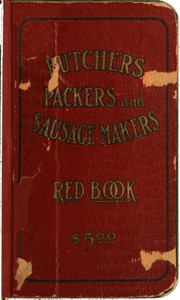
Butchers', Packers' and Sausage Makers' Red Book by George Jacob Sayer
Forget everything you know about modern food production. George Jacob Sayer's Butchers', Packers' and Sausage Makers' Red Book is a direct line to 1914. This book was never meant for casual readers; it was the essential textbook for anyone in the meat business.
The Story
There's no plot in the traditional sense. Instead, the book lays out, in meticulous detail, the entire craft of butchery and meatpacking as it existed before World War I. It covers everything: how to humanely slaughter animals, the proper cuts of meat, recipes for countless types of sausages and cured hams, and even how to run a profitable shop. It's a masterclass in a trade that was central to community life.
Why You Should Read It
This book captivated me because of its sheer, unvarnished practicality. You're not getting a romanticized history lesson. You're getting the raw instructions—the exact temperatures, the specific spices, the warnings about spoiled meat. It makes you appreciate the skill and knowledge that went into something as simple as a breakfast sausage. Reading it, you feel the weight of responsibility these tradespeople carried for public health and quality.
Final Verdict
This is a book for the deeply curious. It's perfect for food history nerds, culinary professionals who want to see their roots, or anyone who loves primary source material that shows how people really worked and lived. It's not a page-turner, but it's an utterly unique and absorbing snapshot of a lost world. Just maybe don't read it right before lunch.
This book is widely considered to be in the public domain. You are welcome to share this with anyone.
Jessica Thompson
4 months agoI started reading this with a critical mind, the bibliography and references suggest a high level of research and authority. A rare gem in a sea of mediocre content.
Paul Gonzalez
1 year agoBefore I started my latest project, I read this and the logic behind each conclusion is easy to follow and verify. It’s hard to find this much value in a single source these days.
Charles Miller
5 months agoI was particularly interested in the case studies mentioned here, the author manages to bridge the gap between theory and practice effectively. It’s hard to find this much value in a single source these days.
George Williams
1 year agoFrom a researcher's perspective, the author clearly has a deep mastery of the subject matter. A trustworthy resource that I'll keep in my digital library.








Nancy Wilson
8 months agoUnlike many other resources I've purchased before, the transition between theoretical knowledge and practical application is seamless. Truly a masterpiece of digital educational material.