
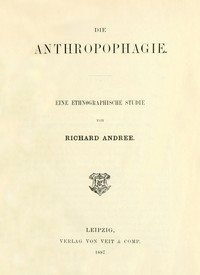
Die Anthropophagie by Richard Andree
Richard Andree's Die Anthropophagie is a collection, not a novel. Published in the late 19th century, it compiles first-hand reports, travelogues, and anthropological notes from around the world that document instances of cannibalism.
The Story
There's no single plot. Instead, Andree acts as an editor, presenting a series of accounts. You'll read about shipwreck survivors in the Pacific, explorers in the Amazon, and colonial officials in Africa. Each story details encounters with groups for whom eating human flesh was part of warfare, ritual, or survival. The book moves from continent to continent, building a grim global picture of this practice through the often-shocked and biased lens of 19th-century European witnesses.
Why You Should Read It
This book gets under your skin. It's not sensationalist gore; it's the cold, clinical reporting that makes it so effective. You're left to wrestle with the huge gap between the writers' horror and the cultural normalcy described. It forces you to think about the absolute limits of cultural understanding and the stories we tell about 'civilization.' Reading it today, you also get a fascinating meta-layer: you're seeing indigenous practices through Victorian eyes, and then seeing those Victorians through your own modern perspective. It’s a double history lesson.
Final Verdict
Perfect for readers of dark history, anthropology, or anyone who likes their non-fiction to deliver a genuine chill. If you enjoy books that explore extreme human behavior and the uncomfortable edges of cultural relativism, this is a forgotten classic. Fair warning: some passages are graphic and the colonial-era attitudes can be jarring. But if you can read it as a historical document of its time, Die Anthropophagie is a uniquely disturbing and memorable deep dive into the ultimate taboo.
This book is widely considered to be in the public domain. You do not need permission to reproduce this work.
Joshua Ramirez
2 years agoLoved it.
Linda Walker
2 years agoFinally a version with clear text and no errors.
Jennifer Moore
7 months agoI started reading out of curiosity and the author's voice is distinct and makes complex topics easy to digest. A true masterpiece.
Nancy Wright
8 months agoJust what I was looking for.




Michael Scott
8 months agoUsed this for my thesis, incredibly useful.