
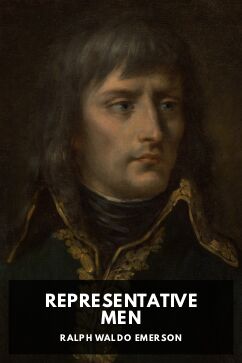
Representative Men - Ralph Waldo Emerson
Forget everything you know about standard biographies. 'Representative Men' is not a history lesson. It's a series of seven essays where Ralph Waldo Emerson, the father of American transcendentalism, sits down with six figures he considers pillars of Western thought and action. He starts with 'Uses of Great Men,' setting up his whole idea: these people are lenses that focus the light of human potential for the rest of us.
The Story
There's no traditional plot. Instead, Emerson takes us on a guided tour of six monumental lives: Plato the philosopher, Swedenborg the mystic, Montaigne the skeptic, Shakespeare the poet, Napoleon the man of action, and Goethe the writer-scientist. For each, he zooms in on what made them tick. What was the core energy of Napoleon's ambition? How did Shakespeare become a vessel for all of human experience? He praises their strengths but isn't afraid to point out their flaws and limitations. The 'story' is really the journey of Emerson's own mind as he connects the dots between them, searching for the common thread of greatness.
Why You Should Read It
You should read this if you love ideas more than gossip. Emerson makes you feel like you're in a room with him, watching him think out loud. His writing is dense and poetic, but when a sentence clicks, it lights up your brain. My biggest takeaway wasn't facts about Napoleon, but Emerson's radical idea: these giants are not aliens. They are you and me, just with their talents fully realized. They 'represent' the possibilities within every person. It’s incredibly empowering. He also has these surprising, sharp opinions—his take on Shakespeare's relatability is fantastic, and his view of Napoleon as a force of nature, not just a general, is refreshing.
Final Verdict
This book is perfect for curious readers who don't mind working a little for their rewards. It's for anyone interested in philosophy, leadership, history, or creativity. If you enjoy authors like Seneca or modern thinkers like Malcolm Gladwell who analyze patterns of success, you'll find Emerson to be the profound, poetic originator of that style. It's not a quick read—you'll want to take it an essay at a time—but it's a book that sticks with you. You'll find yourself seeing 'representative' greatness in people long after you've turned the last page.
This content is free to share and distribute. You do not need permission to reproduce this work.
James Hernandez
2 months agoI took detailed notes while reading through the chapters and the data points used to support the main thesis are quite robust. Finally, a source that prioritizes accuracy over hype.
John Miller
11 months agoLooking at the bibliography alone, the clarity of the writing makes even the most dense sections readable. It definitely lives up to the reputation of the publisher.
Linda Smith
2 years agoIt effectively synthesizes complex ideas into a coherent whole.
Aiden White
2 years agoMy professor recommended this, and I see why.







Richard Rodriguez
4 months agoFrom a researcher's perspective, the level of detail in the second half of the book is truly impressive. A refreshing and intellectually stimulating read.