
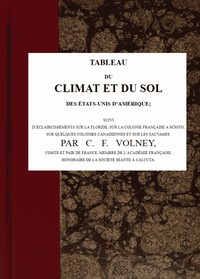
Tableau du climat et du sol des États-Unis d'Amérique by C.-F. Volney
Forget dusty history books for a moment. This is a travelogue from a world that's vanished. In the late 1790s, French philosopher Constantin-François Volney arrived in America, fresh from the upheavals in his own country. He wasn't just visiting cities; he was on a scientific mission. He wanted to understand the very foundation of the United States—its physical land. He journeyed through forests, across rivers, and into frontier settlements, meticulously recording temperatures, rainfall, soil types, and the health of the people he met.
The Story
There's no traditional plot, but there is a driving question: Can this new republic last? Volney believed a nation's destiny was tied to its environment. He connects swamps to disease, rich soil to potential wealth, and harsh climates to tough settlers. He writes about Native American mounds, speculates on climate change, and warns about deforestation. The 'story' is his quest to map the character of America itself, piece by piece, from the ground up.
Why You Should Read It
It makes you see history differently. You feel the immense, raw challenge of the continent. When Volney worries about soil exhaustion, you understand the real, physical anxieties behind the political speeches. His outsider perspective is gold—he notices things Americans of the time might have missed. It's part adventure, part science report, and entirely a portrait of a nation still figuring itself out.
Final Verdict
Perfect for history buffs who want to get their boots muddy, or for anyone who loves the idea of early American science and exploration. It's not a fast-paced novel, but if you enjoy primary sources that let you touch the past, this is a remarkable journey. Think of it as the 18th-century blog of a very sharp, very observant traveler.
This historical work is free of copyright protections. It is available for public use and education.
Mary Gonzalez
11 months agoThe balance between academic rigor and readability is perfect.
Barbara Lopez
4 months agoI wanted to compare this perspective with traditional views, the step-by-step breakdown of the methodology is extremely helpful for students. Top-tier content that deserves more recognition.
Nancy Harris
2 years agoI decided to give this a try based on a colleague's recommendation, the insights into future trends are particularly thought-provoking. This adds significant depth to my understanding of the field.
Christopher Thomas
1 month agoGiven the current trends in this field, the structural organization allows for quick referencing of key points. I'll be citing this in my upcoming project.


Robert Anderson
2 years agoOne of the most comprehensive guides I've read this year.